

Hi, if you don’t know me, I’m Dr Theresa Orr.
You’re welcome to learn more about how I help students succeed at university with my Uni Pro Accelerator Course.
At some point in your degree, you’ll almost certainly be asked to write a literature review. But what they don’t tell you is that there’s actually more than one type.
In fact, there are six types of literature reviews: Integrative, Meta-analysis, Scoping, Systematic, Rapid and Traditional (also called Narrative). Thankfully as undergraduates, you’ll almost always be asked for a traditional/narrative review. Whereas if you’re a postgraduate student, you might also need to write a systematic review.
Let’s break down what each type of literature review involves (how they’re different), and then I’m going to explain the traditional and systematic reviews in more detail since they’re the ones you’re most likely to write while you’re at university. That way you can write your own review quickly and easily.
You can also watch my video on literature reviews here:
1. Integrative Literature Review
An integrative literature review does exactly what it sounds like: it integrates two types of knowledge. It brings together the practical side of research (what works in real life) and the theoretical side (why or how it works) to answer a research question.
This type of review is bigger than most because it includes not just research findings, but also theories, perspectives or points of view, and sometimes even practice-based reports. It’s most often used in health, education, and social sciences, which are fields where both “what happens in practice” and “why it happens” matter.
Example
Imagine you’re researching whether mindfulness programs help university students manage exam stress.
- The practical studies might show that students who practice mindfulness techniques have lower stress scores.
- The theoretical studies might explain this by linking mindfulness to reduced cortisol levels or improved focus.
An integrative review would combine both sides: the evidence that mindfulness works and the theories that explain why.
Integrative literature reviews:
- Give a more complete picture of a topic.
- Highlight connections between practice and theory.
- Can identify gap (e.g., lots of theory but not much practical evidence, or the other way around).
💡Tip
If you’re asked to write an integrative review:
- Look for patterns across practice and theory, where do they support each other, and where do they clash?
- Explain why it matters that both (practical and theoretical) are considered together in your topic.
- Make sure you include both kinds of sources (research findings + theories).
2. Meta-Analysis
Hi, if you don’t know me, I’m Dr Theresa Orr.
You’re welcome to learn more about how I help students succeed at university with my Uni Pro Accelerator Course.
A meta-analysis is a type of literature review that combines the results of many different studies to answer one specific research question. I’ll be the first to admit that a meta-analysis sounds just like any other literature review, but the difference is instead of just writing about what each study found, it actually adds all the results together. In fact, a meta-analysis usually uses statistics to pool all the data together (almost like into one big study).
This makes the conclusions stronger, because it’s not based on one small study, but on a whole collection of them. Meta-analyses are especially common in health, psychology, and sciences, where researchers want reliable answers to questions like “Does this treatment really work?” or “Is this effect consistent across different groups of people?”
Example
Imagine you’re researching whether exercise helps reduce symptoms of depression.
- One study might show a small improvement.
- Another might show a big improvement.
- A third might show no effect at all.
On their own, these results look inconsistent. But a meta-analysis would combine all of these studies’ results into one big analysis. If, overall, the majority of evidence shows exercise reduces depression, then the conclusion is much stronger.
Meta-analysis literature reviews are useful because they:
- Reduce the chance that results are just “luck” from one small study.
- Help identify whether results are consistent across different groups, places, or methods.
- Can show trends that aren’t obvious in individual studies.
💡Tip
If you’re asked to write about or use a meta-analysis in your assignments:
- Remember that meta-analysis = summary with statistics, not just “lots of articles put together.”
- Pay attention to the sample size. The bigger the meta-analysis (more studies included), the stronger the findings usually are.
- Don’t just copy the conclusion. Look at whether the authors mention limitations (for example, if most of the studies came from one country, or only tested a narrow group of people).
3. Scoping Review
A scoping review just provides an overview of a research topic. It doesn’t go into every detail or result, it just maps out what’s out there. Scoping reviews usually include the range of studies, what kind of research has been done, and where the gaps are (but not what the results of the research was).
Think of it as a way to describe a landscape: it shows you the size, shape, and variety of studies on a topic, but not the fine detail of each one.
Scoping reviews are often used when a topic is broad or new, and researchers want to understand how much has already been studied before deciding whether to dive deeper.
Example
Imagine you’re interested in climate anxiety in young people.
- A scoping review wouldn’t give you the exact statistics from every study.
- Instead, it would tell you: how many studies exist, what types of studies they are (surveys, interviews, experiments), which countries they come from, and what aspects of climate anxiety they focus on (stress, activism, coping strategies).
In other words, you’d come away with a map of the research area, rather than a detailed analysis of results.
Scoping reviews are written because they:
- Help researchers see what’s already been studied (and what hasn’t).
- Show whether there’s enough research to do a deeper review, like a systematic review.
- Useful when you’re just starting out in a new area of research (and help you to decide whether doing more research in this area is even worth it!)
💡Tip
If you’re asked to write about or use a scoping review:
- Focus on the range of studies, not the detail, so what areas are covered, what kinds of studies exist etc.
- Highlight any gaps (e.g., “most studies are from the US, very few from Australia”).
- Don’t get bogged down in data tables. The point is to show the range of research, not the exact numbers.
4. Systematic Review
A systematic review is the most detailed type of literature review you’ll ever come across. And yes, they take the longest, which is why they’re usually written during post grad years and rarely seen during our undergraduate. The aim of a systematic review is to look at every single piece of research that answers a specific question, and then bring it all together into one big review.
What makes a systematic review different is the use of a clearly defined search strategy. That means before you even start, you decide exactly:
- what databases you’ll search (e.g., PubMed, PsycINFO, Google Scholar),
- what keywords you’ll use,
- what types of studies you’ll include (only journal articles? studies after 2000? research from certain countries?),
- and what types of studies you’ll exclude.
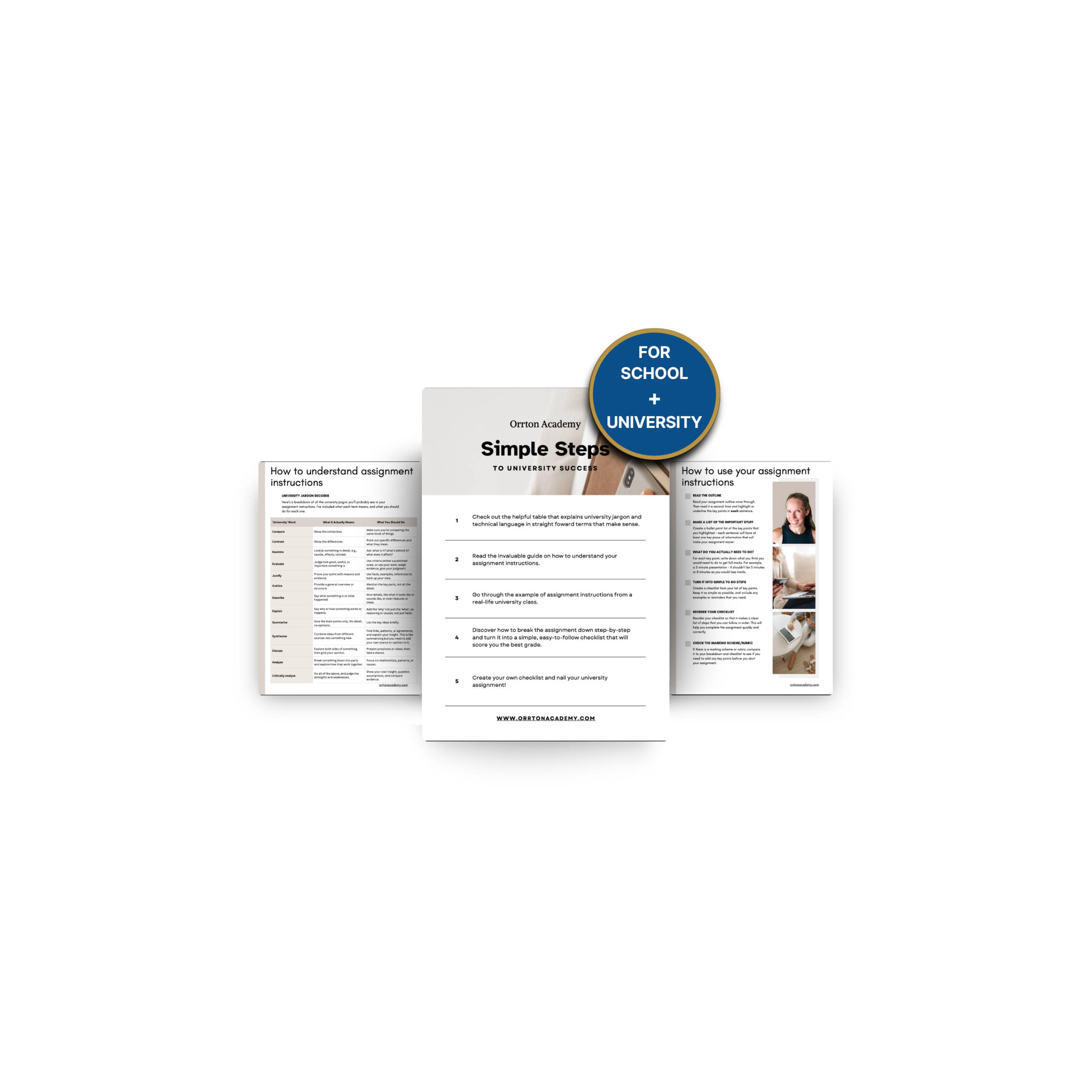
FREE ASSIGNMENT GUIDE
Developed by Dr Theresa Orr.
You’re very welcome!
Because it follows such a strict process, the results are seen as more reliable and unbiased than other types of reviews. But it also means systematic reviews are very time-consuming and usually reserved for postgraduate study or professional research.
Example
Suppose your research question is: “Does screen time affect children’s sleep?”
- A systematic review would search all the relevant databases using a set of agreed search terms (like “screen time,” “children,” and “sleep”).
- It would then screen thousands of articles, exclude ones that don’t meet the criteria, and include only those that directly answer the question.
- The end result is a huge, detailed report that shows the overall answer across all the best available studies.
Systematic reviews:
- Are considered the “gold standard” of evidence in fields like medicine, psychology, and education.
- Reduce bias by being transparent about exactly how studies were chosen.
- Give a clear, evidence-based answer to a specific research question.
💡Tip
If you’re ever asked to write or use a systematic review:
- Be clear about your search strategy in the introduction (databases, dates, keywords, inclusion/exclusion criteria) before you start searching. Include this search strategy in your introduction.
- Stick to the process. Don’t add or drop studies halfway through because it makes the review less credible.
- If you’re an undergrad, you probably won’t be asked to write a full systematic review (phew!), but you might be asked to use one as a source or write about one.
5. Rapid Review
A rapid review is exactly what it sounds like… a quicker, lighter version of a systematic review. Instead of spending months (or even years) reviewing every single study in detail, rapid reviews get an answer faster by.
- searching fewer databases,
- including fewer studies,
- or skipping some of the steps (like double-checking every study for bias).
Because it’s faster, the results aren’t as complete or reliable as a systematic review, but they’re good enough to give us an idea of what research is already out there.
Example
Imagine a research team is thinking about running a study on whether online learning improves student grades compared to in-person classes.
Before spending months (and thousands of dollars) on the project, they might do a rapid review. This would quickly show:
- how many studies already exist,
- whether the results look promising,
- and whether their proposed study is worth doing.
Rapid reviews help us because they:
- Save time and resources when a full systematic review isn’t practical.
- Help researchers decide if a new study is needed or if the question has already been answered.
- Provide a quick evidence snapshot for policy-makers, educators, or health professionals who need answers fast.
💡Tip
If you’re reading or using a rapid review in your uni work:
- Remember it’s not as thorough as a systematic review, it might miss some studies (and that’s okay!).
- Always check the limitations section to see what was left out. This is especially useful if you’re asked to write about a rapid review, highlighting the limitations will usually get you better marks.
- If you’re comparing different review types in an assignment, you can think of a rapid review as “systematic review lite.”
6. Traditional (Narrative) Review
A traditional (or narrative) review is the type of literature review you’re most likely to write as an undergraduate. Unlike a systematic review, it doesn’t try to cover every single study ever published. Instead, it aims to summarise, synthesise, and critically analyse the literature on your topic.
To be honest, I’ve always found words like ‘synthesise” and “critically analyse” frustrating because no-one explains what they really mean. But the key here is that you need to add something yourself. So instead of just retelling what other people have written. You need to spot patterns, gaps, strengths, or weaknesses in the research (as a whole) and then talk about them. You can read more about how to do that here.
Basically though, synthesise means bringing different studies together to show the bigger picture and critically analyse means pointing out what’s strong, weak, or missing.
Example
Let’s say you’re writing a review on the impact of social media on university students’ mental health.
- You might group the studies into themes: one section on anxiety, one on self-esteem, and one on social connection.
- Within each theme, you would explain what researchers agree on, where they disagree, and where the evidence is missing.
- You’d also point out strengths and weaknesses. For example, that many studies are self-reported surveys (which can be biased), while only a few are long-term studies.
So you’re not just saying “Here’s what’s been studied.” You’re saying “Here’s what we know, here’s what we don’t, and here’s how reliable the evidence is.”
Traditional literature reviews are often used for assignments because they:
- Show you can evaluate and interpret research, not just list it.
- Show you can identify gaps that future studies could fill.
- Trains you to build an argument based on evidence, which is a skill you’ll use in almost every other assignment (and later on in the workplace).
💡Tip
If you’re writing a traditional literature review for your assignment:
- Don’t just summarise. Make sure you include your own analysis of what the research means (I like to do this in a graph if possible).
- Organise your body paragraphs clearly. I always recommend using one of these approaches:
- Geographical (by location, e.g., US vs Europe vs Australia)
- Chronological (by time period, e.g., 1990s, 2000s, 2010s)
- Thematic (by idea/topic, e.g., anxiety, self-esteem, social connection)
- Thematic is often the easiest and most flexible option for all types of assignments.
- Always link back to your research question or assignment topic in your conclusion.
Traditional vs Systematic Reviews
Traditional and systematic reviews are the two types you’ll most often be assessed on during your university years, so let’s look at them more closely.
| Feature | Traditional (Narrative) Review | Systematic Review |
|---|---|---|
| Main Purpose | Summarises and critically analyses existing research to show what we know, don’t know, and how reliable it is. | Collects all available research on a question using a strict search process to give the most reliable answer possible. |
| Search Strategy | Flexible: you explain how you searched, but it doesn’t need to cover every study. | Pre-defined and strict: databases, keywords, dates, inclusion/exclusion criteria must be decided and written upfront. |
| Depth | Broad overview with critical commentary. | Comprehensive and detailed, aiming to include every relevant study. |
| Time Required | Faster to complete: common in undergraduate assignments. | Very time-consuming: often months of work, mostly at postgraduate/research level. |
| Focus | Critical analysis: patterns, gaps, strengths, weaknesses. | Evidence-based conclusion to a specific research question. |
| Structure | Intro → Body (often by theme, time, or location) → Conclusion. | Rigid, formal structure — includes methods, search strategy, results, discussion, conclusion. |
| Common Use at Uni | Undergraduate assignments and essays. | Postgraduate theses, dissertations, or published research. |
Traditional Review
- Focus: critical analysis of the literature.
- Beyond summarising: you evaluate strengths, weaknesses, and gaps in the research.
- Structure: introduction → body (organised into categories) → conclusion.
- Common body paragraph structures:
- Geographical – e.g., comparing research in the US, Europe, and Australia.
- Chronological – e.g., tracing how medical practices changed from the 1990s through to the 2020s.
- Thematic – organising by topic or idea (the most flexible and widely used).
Systematic Review
- Focus: answering a research question by reviewing all relevant studies.
- Requires a clear, pre-defined search methodology (e.g., only journal articles since 2000, only studies in Australia, only a certain population group).
- The introduction must include your search strategy and selection criteria.
- Rigidly structured and very comprehensive. Whole sections of a review could be devoted to a single theme, which then may have its own internal structure e.g, chronological.
- Time-intensive, which is why they’re more common at postgraduate level.
Structuring Your Literature Review
No matter which type of literature review you’re writing, they all follow the same overall structure:
- Introduction: introduce your topic and outline how you searched for the literature.
- Body: discuss and analyse the literature using one of the common structures (geographical, chronological, thematic).
- Conclusion: summarise the state of knowledge, highlight gaps, and link back to your research question or assessment task.
Before you start your next assignment, consider this…
Knowing exactly what the question is asking can save you hours of unnecessary research and writing.
I’ve put together the process I teach to break assignment instructions down step by step.
And you can get it for FREE below.
FREE ASSIGNMENT GUIDE
Developed by Dr Theresa Orr.
You’re very welcome!