

Hi, if you don’t know me, I’m Dr Theresa Orr.
You’re welcome to learn more about how I help students succeed at university with my Uni Pro Accelerator Course.
The hardest part about writing a literature review is learning how to synthesize the research instead of just summarizing it.
A summary is where you take what you read, and reduce it down in size into your own words, highlighting what the main point is. But when you synthesize you actually combine all the information together that you’ve reviewed to discover a new idea or a new point of view that is completely from you, and that is what
you need to write and what your lecturer wants.
To get top marks, you always need to go a step further: combine what you’ve read and show your own point of view by synthesizing. So, let’s break down the difference between summarizing and synthesizing, with clear examples.
You can also watch my video on how to synthesize in your literature review here:
Summary Vs Synthesis
A summary reports what each author says, whereas a synthesis shows what you think those authors are saying together. The key difference is what the authors are saying vs what you think about what they’re saying. Here’s some more detail to make it a bit clearer:
Summary
A summary is when you take what you’ve read and reduce it down into your own words, focusing only on the main point.
- It’s shorter than the original.
- It keeps the meaning of the original author.
- It doesn’t add your own thinking, you’re just reporting back what you’ve read.
Think of a summary like writing a movie recap: “In Finding Nemo, a clownfish loses his son and travels across the ocean to find him.” You’ve captured the general idea, but you haven’t added anything new.
💡Tip
If you’re asked to write a summary in an assignment:
- Stick to one source at a time.
- Shrink it down into your own words.
- Keep the focus on what the author said, not your opinion.
Synthesis
A synthesis goes further than a summary. Instead of just repeating what each author says, you combine multiple sources together to create a bigger picture, and then add your own point of view (this is the most important part of a synthesis).
- You discuss the studies together instead of just lining up one study after another.
- You show how the studies are connected.
- You point out patterns, strengths, weaknesses, contradictions, or gaps.
Think of synthesis as writing a movie review instead of a recap: “Finding Nemo is about family and resilience. The film shows how love drives us to face challenges, and it highlights the importance of community when Marlin meets Dory and others along the way.” Here, you’ve taken all the details and created a new idea that’s yours.
My favorite way to synthesize is to create an image. You’re guaranteed to get a great mark, and writing the body paragraphs is instantly easier. Read more about how to create your own synthesis image here.
💡Tip
If you’re asked to write a synthesis in a literature review:
- Pull together ideas from multiple sources in one paragraph.
- Start with a statement sentence (your point of view).
- Use the studies as evidence to support that point.
A quick way to check if you have summarized instead of synthesized: if your paragraph could be rearranged without losing meaning (Study A, then Study B, then Study C), it’s probably just a summary. If your paragraph wouldn’t make sense without all the studies being linked under one idea, that’s a synthesis.
Check out the table below for a breakdown of the differences between a summary and a synthesis:
| Feature | Summary | Synthesis |
|---|---|---|
| Definition | Shortens a single source into your own words, keeping only the main point. | Combines ideas from multiple sources to create a new point of view. |
| Purpose | Show you understand what one author is saying. | Show you can connect sources, spot patterns, and form your own argument. |
| What It Looks Like | One sentence per article, lined up one after another. | One paragraph that blends studies together under one clear idea. |
| Your Role | Reporter: you’re passing on what the author said. | Thinker: you add your own analysis of what the studies mean together. |
Example: Summary vs Synthesis
Let’s look at an example to make it easier for when you need to write your own literature review:
❌ Summary (what not to do)
Researcher Taylor found that teens need at least 9 hours of sleep for optimal function. Lee conducted a study showing that most high schoolers get only 6 to 7 hours of sleep per night. Patel reported that late night screen time contributes to poor sleep quality in adolescence.
This is just one sentence from each study. There’s no connection, no opinion, no key point from the writer.
✅ Synthesis (what you should do)
The topic of teenage sleep patterns reveals a complex web of behavioural and environmental factors. Taylor highlights a gap between needed and actual hours of sleep, with teens requiring around nine hours for optimal health. Lee’s study shows this standard is not being met, with the average teen sleeping only 6–7 hours. Patel links this problem to modern habits, specifically the use of screens before bed. Taken together, these studies suggest that future interventions need to address both sleep duration and sleep quality, considering the strong influence of technology on bedtime routines.
Here, the writer connects the studies into one bigger point: not just what each study says, but what they mean together.
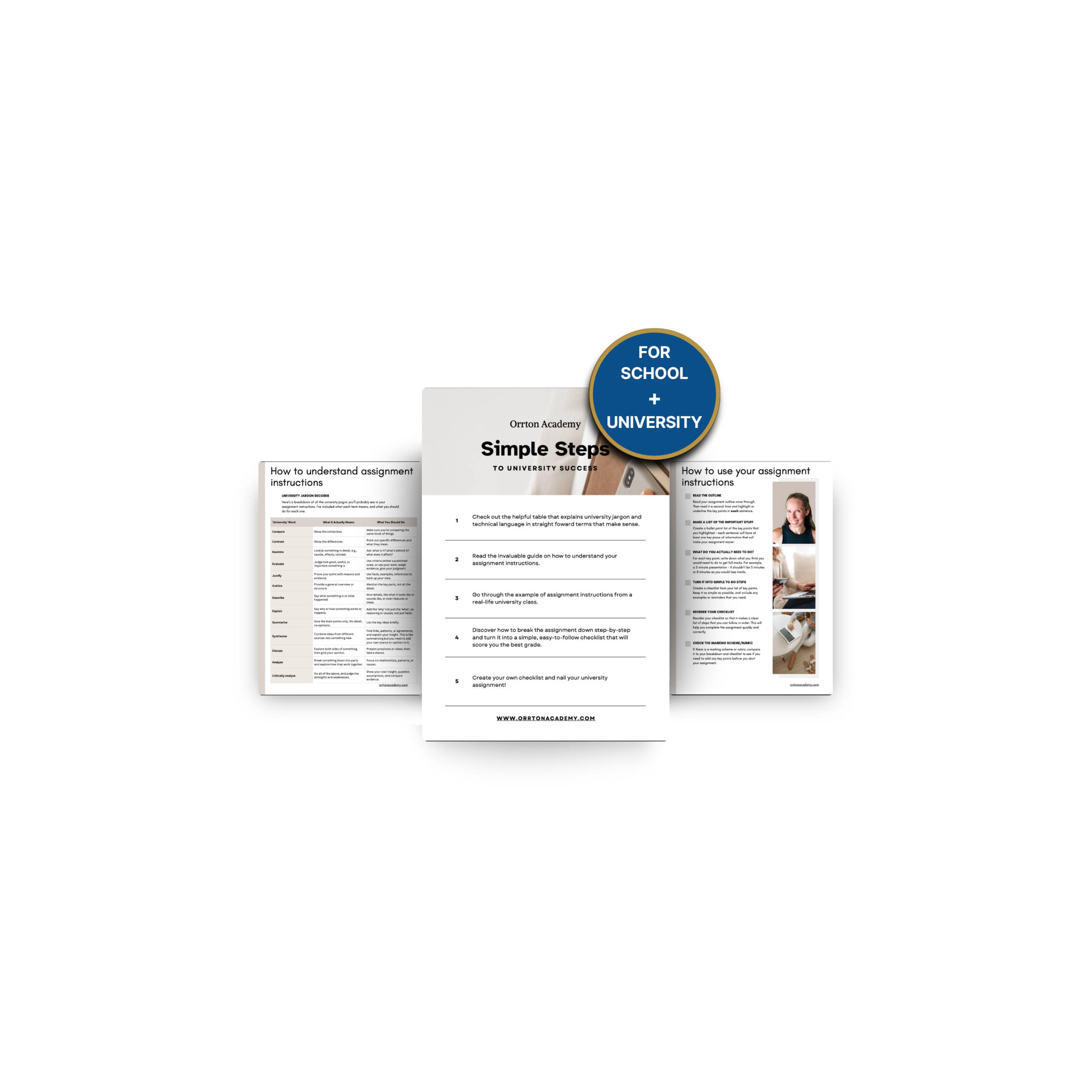
FREE ASSIGNMENT GUIDE
Developed by Dr Theresa Orr.
You’re very welcome!
How to Start Synthesizing
The easiest way to make sure you’re actually synthesizing (and not just summarizing) is to begin with a statement sentence (like a topic sentence) at the start of each paragraph. These sentences state the point you’re trying to make, and then the rest of the paragraph brings in the sources to support it. The type of topic sentence you need, and how you’ll structure your review overall will depend on what type of literature review you’re writing. You can read more about the different types of review and how to structure them here.
Here are some example statement sentences for the start of your paragraph:
- “Technology is one of the biggest barriers to healthy teenage sleep patterns.”
- “Social media use is linked to lower self-esteem in university students.”
- “Research on online learning shows mixed results depending on subject area.”
Once you’ve written your statement sentence, you can bring in different studies that relate to that point.
A Practical Writing Trick
Before you start writing, try this quick method:
- List your key points as bullet points (the things you want your body paragraphs to say).
- Under each point, jot down which sources you’ll use to support it.
- Then, turn those bullets into full paragraphs when you write.
This keeps your paragraphs focused and ensures you’re combining sources under one clear idea — not just summarizing them one by one.
Before you start your next assignment, consider this…
Knowing exactly what the question is asking can save you hours of unnecessary research and writing.
I’ve put together the process I teach to break assignment instructions down step by step.
And you can get it for FREE below.
FREE ASSIGNMENT GUIDE
Developed by Dr Theresa Orr.
You’re very welcome!