
Hi, if you don’t know me, I’m Dr Theresa Orr.
You’re welcome to learn more about how I help students succeed at university with my Uni Pro Accelerator Course.
This year has seen more students falsely accused of using AI than any other. And the fallout has been brutal, innocent students have failed subjects, lost scholarships, had their visas suspended, and even faced expulsion.
If you’ve been falsely accused of using AI start by asking for the flagged report so you know exactly what part of your assignment is in doubt. Then, build a process record that includes your drafts, version histories, notes, and research evidence (e.g., highlighted PDFs). You can also question what AI-detection tool was used and how the result was determined.
In this post, I’ll explain why your writing might be falsely flagged as AI, how to create a strong process record step-by-step, and what to do if your university accuses you (whether you use AI or not).
You can also watch my video on what to do if you’re falsely accused of using AI here:
Why So Many Students Are Being Falsely Accused
2025 has seen more false AI accusations than any other year. The problem is that real student writing is being flagged as AI-generated, especially if it’s polished or grammatically correct. Even the grammar and spell-check plugins from Grammarly, and the humanizer tool from Quillbot are being flagged as AI now.
But in reality AI detectors don’t actually detect AI. They calculate a probability that your text might be written by machine, based on how predictable or grammatically perfect it sounds.
If your writing is too perfect, too formal, or too consistent, it can trigger a red flag. That means using university-approved tools like Microsoft Word Editor, Grammarly or Google’s grammar checker can put you at risk.
Even the US Constitution has been flagged by AI detectors as “AI-written.” So no… it’s not just you.
Real consequences
False accusations still have serious real-world consequences:
- failed subjects
- revoked scholarships or internships
- suspended visas
- academic misconduct records
- course suspension or expulsion
A lot of innocent students have lost their appeals because they had no evidence to show they are innocent. All because of software that provides no proof, just probabilities.
How to Protect Yourself from False Accusations of Using AI
You can’t control the AI-detector, but you can still protect yourself.
1. Keep a Process Record
This is the single best way to prove your work is yours. You want your process record to show every edit, addition, or correction.
Turn on Track Changes in Microsoft Word or use Version History in Google Docs.
This way all of your changes are automatically saved with a timestamp.
If you’re ever accused, your document (and version history) becomes your writing evidence, it’s a clear record that shows when and how your assignment was written and edited (not by AI).
💡Tip
If you write in multiple documents, name them clearly:
Essay_Draft1,Essay_Draft2_Edited,Final_Submission.
That naming trail alone shows you have a genuine writing process.
In fact, I would use track changes in Word, then once I had my first draft complete I would save it as Essay v1, then I would create a new one as Essay v2. That way if my track changes got too overwhelming I would just create a new document version. To this day I still do this with my research papers (my last paper ended up at v7).
2. Save Your Research
Your research trail is the second biggest part of your defense.
- Use a reference managing software like EndNote or Zotero to store every journal article you read or cite (most university’s pay for licenses for their students, so it should be free)
- Save the PDFs in the software
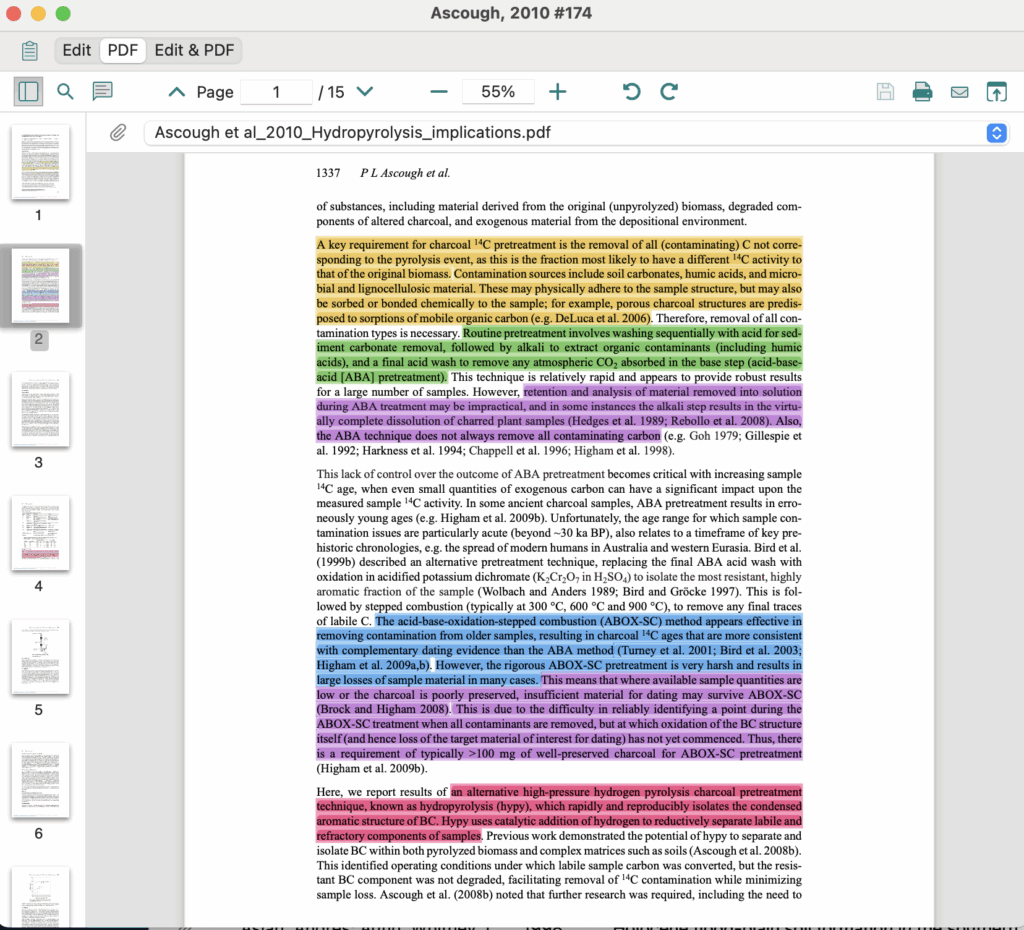
- Highlight and make notes on the PDFs inside the software (not externally)
The notes and highlights prove you did the research yourself and show how your ideas developed from real sources, not AI prompts.
Example
Here’s an example of one of my PDFs, I use different colors for different meanings (e.g., green for definition or plain explanations, yellow for background info)
While you’re at it, avoid using ChatGPT to find research sources for you (or write your papers for you obviously)…if you’ve ever wondered how your lecturer will know you’ve used it (without ever using an AI-detector then check out this article).
3. Record Your Work (Optional)

FREE ASSIGNMENT GUIDE
Developed by Dr Theresa Orr.
You’re very welcome!
Okay, this is a bit extreme… but screen recording while you write or research can show your process and authorship.
Think of it as extra proof if things ever go wrong. I’m not recommending this one (usually a process record and research trail is enough), but it’s a viable option if you want to go this far.
💡Tip
Have it set up so your screen recording automatically saves to a cloud location and doesn’t clog up your computer space. That way you’ll have access to it if you ever need it.
4. Write Like You
In a world filled with word documents written in the voice of ChatGPT, your best protection is your own voice.
Avoid changing your natural writing style just to sound “smarter” or more academic, believe it or not but that’s often what triggers false AI flags. AI detectors look for perfectly structured sentences and predictable patterns, so if your writing suddenly shifts from conversational to robotic, it stands out (for all the wrong reasons).
It’s one of the reason international students are being accused more often than native english speakers, because they have learned how to write grammatically correct. Whereas as a native speaker and writer we tend to write more in our own style (it’s more about how our brains think and how we talk).
Read everything you write out loud. If it doesn’t sound like you, rewrite it.
Example
If you normally write:
“This shows how water moves through the soil.”
But suddenly switch to:
“This exemplifies the hydrological transfer processes within pedological systems.”
That’s not you anymore, and it might get flagged.
You can read more about how to write at university here.
5. Avoid Paraphrasing and Humanizer Tools
Whatever you do, don’t use Quillbot or Grammarly’s rewrite features, or any other “AI reworder” or “humanizer” tools.
They’re marketed as ways to “beat AI detection,” but in reality, they make your writing sound too perfect and too predictable, exactly what Turnitin’s AI-detection tools flag as AI-generated.
If you need to fix a sentence, do it yourself:
- Change one phrase
- Move a clause
- Break a long sentence into two shorter ones.
That still improves your writing, but it keeps your tone and structure natural.
💡Tip
Instead of using AI methods to improve your writing use journal articles from your research:
- Look for sentences or paragraphs that you like in the articles you used for your assignment
- Use some of their words or sentence structure in your own writing (obviously don’t copy it)
If You’re Accused, You Have Rights
If your university accuses you of using AI, don’t panic, and don’t accept the accusation without evidence from them.
You’re entitled to know exactly what’s being questioned and why:
- Ask to see the flagged sentences. You need to know which parts of your writing they believe were AI-generated.
- Request the name and version of the detection tool used. Different tools (and even updates) produce different results.
- Ask what evidence they have of authorship. A highlighted Turnitin report isn’t proof, it’s just probability. They need more than this.
If they can’t show clear evidence, there is no proof, only an assumption made by software. But your process record (your drafts, version history, and notes) is evidence and your defense.
Before you start your next assignment, consider this…
Knowing exactly what the question is asking can save you hours of unnecessary research and writing.
I’ve put together the process I teach to break assignment instructions down step by step.
And you can get it for FREE below.
FREE ASSIGNMENT GUIDE
Developed by Dr Theresa Orr.
You’re very welcome!