
If you want to write your essays faster, start with an outline. I used to hate doing them because they always felt like a waste of time, but then I realised it was because I didn’t know how to do one properly (and quickly). An essay outline isn’t just a rough sketch of ideas or a pile of bullet points. It’s a full working plan that tells you what to write, where to write it, and what evidence to include, so it makes writing the essay easy.
To write an effective essay outline you need to add information, evidence and citations for the key parts of your introduction, body paragraphs and conclusion. These include sections like the thesis statement, signpost sentences, key themes, supporting points, and even a final statement.
In this guide (and the video below), I’ll walk you through how to create an outline that includes everything you need, including your introduction, body paragraphs, and conclusion, before you write a single sentence of your actual essay. I’ve also included a full example of an essay outline at the end to make it easier for you.
You can also watch my step-by-step video on how to write an essay outline:
Step 1: Outline Your Introduction
The introduction of your essay explains what the rest of your essay will be about, so your outline should include four these main points:
1. Overall Topic or Theme
Start by writing down the broad topic of your essay. Your lecturer will usually give this to you in your assignment instructions, but not always. Here’s an example:
“The impact of regular exercise on academic performance.”
2. Background Context
For the background context you want to add bullet points for any theories, definitions, or debates related to your topic. What you include here will change depending on the type of essay you have (more on that here), but if you focus on explaining the very basics of your topic so anyone can understand it, then you’ll have done it right.
I find it best to write down the background context in bullet points, here’s what to include:
- Key terms or concepts you want to make sure your reader, and the person marking your essay, understands your topic before you launch into your thesis statement (that’s coming up next).
e.g. “regular physical activity”, “Cognitive load theory,” “self-efficacy,”
- Relevant theories or frameworks that underpin your essay
e.g. “Maslow’s hierarchy of needs,” “social learning theory”
- Major debates, perspectives, or positions (especially if your essay compares them later)
e.g. “Whether academic stress is caused more by workload or poor time management”
- Any context that helps explain why this topic matters right now
e.g. “Growing concerns over university student mental health post-pandemic”
Remember you don’t need full sentences here, bullet points are fine. The goal is to make sure that when you come back to write the actual essay, you already know what the basic info is that needs to go in your introduction (and in what order).

Hi, if you don’t know me, I’m Dr Theresa Orr.
You’re welcome to learn more about how I help students succeed at university with my Uni Pro Accelerator Course.
3. Thesis Statement
Your thesis statement is the single most important sentence in your entire essay, and there’s always marks allocated for it. The thesis statement says exactly what you’re arguing or what position you’re taking for your entire essay. For example if your essay was overall positive or negative about a topic you would be able to see that in your thesis statement.
In your outline, this is one of the only parts I recommend writing as a complete sentence, not a bullet point. That way, when it comes time to write your essay, you can copy and paste it straight in, no extra thinking required, plus it makes researching for each of your body paragraphs easier.
A good thesis statement should:
- Respond directly to your essay question or task
- Clearly state your main argument or claim (not just restate your topic)
- Set up the structure of your body paragraphs (each key point should connect back to your thesis)
- Avoid vague, general statements. You want to be as specific as possible
Here’s the hack: Write your thesis by rewriting your overall theme or essay question by turning it into a statement that includes your position on the topic.
Example Thesis Statement
Topic: The impact of regular exercise on academic performance
Thesis: Regular exercise improves academic performance by enhancing concentration, reducing stress, and supporting memory retention.
This is a strong thesis because:
- It takes a clear position (‘improves‘ means we are saying exercise has a positive impact on academic performance)
- It includes three reasons that will match the body paragraphs
- It’s specific – not just “exercise is important,” but how it helps academically
If you’re struggling to write your thesis in one sentence, try finishing this prompt:
“In this essay, I will argue that…”
Write the full sentence, then delete the prompt, what’s left is often a solid thesis statement.
4. Signpost Sentences
Your signpost sentences are the final part of your introduction. They give your reader a roadmap, they are a preview of the key points or arguments that each body paragraph will discuss. In your outline include one bullet point for each main idea or argument (so one bullet point for each paragraph). These bullet points should:
- Match the order of your body paragraphs
- Match the structure of your thesis statement (what topics or reasons did you include in your statement?)
- Be concise but informative (one sentence per paragraph is usually enough)
A quick trick: Write one signpost sentence for every body paragraph you plan to include. So if you’re writing three body paragraphs, you’ll need three signpost sentences.
Example Signpost Sentences
Thesis:
Regular exercise improves academic performance by enhancing concentration, reducing stress, and supporting memory retention.
Signpost Sentences:
- First, this essay will examine how regular exercise enhances concentration and focus during study.
- It will then explore the role of exercise in managing academic stress and emotional wellbeing.
- Finally, it will discuss how physical activity supports memory retention and long-term learning.
These sentences clearly signal what’s coming in the body section, and they follow the exact structure of the thesis. That makes your essay easier to follow, and more importantly it makes your essay easier to write.
Step 2: Outline Each Body Paragraph
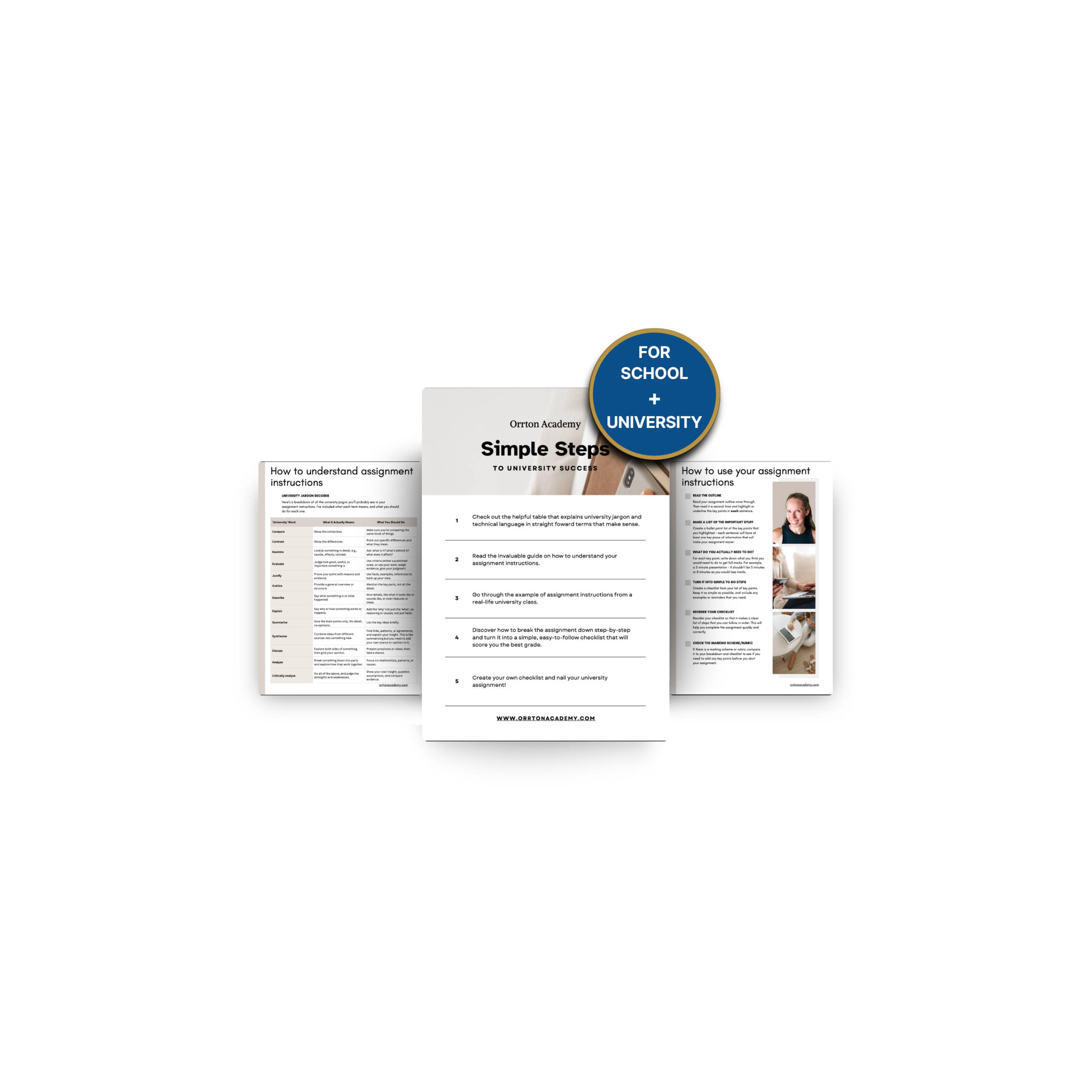
FREE ASSIGNMENT GUIDE
Developed by Dr Theresa Orr.
You’re very welcome!
Your body section should make up 60 – 80% of your total word count. So if you’re writing a 1,000-word essay, aim for 600 – 800 words in this section. This is usually 3 to 4 paragraphs.
Never outline the whole body section as one chunk. I always outline each paragraph individually using this structure:
For Each Paragraph:
1. Paragraph Theme
What’s the main topic or idea this paragraph covers?
Your body paragraphs should focus on just one theme or sub-topic — don’t try to cover everything in one go. Think of each paragraph as answering one part of the overall essay question.
2. Key Point 1
Add a brief bullet or sentence for the first key idea you’re going to explore. This might include background information or context.
- Include your evidence (quote, stat, example)
- Add the citation (so you’re not scrambling to find it later)
3. Key Point 2
Your second point should deepen your argument, ideally through comparison or analysis (instead of just an example or stat)
- Add evidence and a citation again
This simple two-point structure makes paragraphs more focused, helps avoid waffle, and keeps your writing analytical (which markers love). But if you’re writing a shorter paragraph, one strong key point, fully developed with analysis and evidence, can also work.
Repeat this structure for each paragraph. Once done, your body section will be completely mapped out, with evidence and sources already in place. All you have to do is turn these into sentences in your essay and your body paragraphs will be almost instantly written.
There are some great free apps or tools you can use to help write your assessments easily, including your citations – read more about them here.
Step 3: Outline Your Conclusion
Your conclusion should do two things:
- Synthesize the main findings from your body paragraphs
- Leave the reader with something useful, interesting, or forward-looking (and ideally positive)
In your outline, I recommend creating two short sections:
1. Synthesis
This is where you pull everything together, not by repeating your thesis or topic sentences word-for-word, but by showing how your ideas connect and what they add up to.
In your outline:
- Write one full sentence that sums up your overall conclusion. This is the takeaway message you want your reader to leave with.
- Then add 1–2 bullet points explaining why this conclusion matters. Think about: So what? Why does your argument or insight actually matter?
For example:
- Overall outcome: Regular physical activity plays a key role in supporting academic performance across multiple domains, including focus, stress, and memory.
- Why this matters:
- Highlights an overlooked factor in student wellbeing and achievement
- Suggests non-academic interventions (like gym programs) can improve academic outcomes
2. Final Statement (Future Focus)
This is the last thing your reader sees, so make it count!
This section will change depending on the type of essay you have to write, but it might include:
- A recommendation or call to action
- A real-world implication (e.g. for policy, education, or professional practice)
- A question or suggestion for future research
In your outline:
- Bullet point any forward-facing ideas you want to include
- Keep it tight, you only need 1 or 2 strong points
For example:
- Universities should consider offering free or subsidised fitness programs to improve student outcomes
- Future studies could explore whether certain types of exercise (e.g. cardio vs. strength training) have greater cognitive benefits
Ending with this kind of insight gives your essay a confident, polished finish (and better marks).
Example Essay Outline
Essay Topic:
The impact of regular exercise on academic performance
Introduction
- Overall Theme: The link between regular physical exercise and academic success in university students
- Background Context:
- Definition of regular exercise (e.g., 150 minutes of moderate activity per week)
- Overview of cognitive load theory
- Existing research on physical activity and mental health
- Thesis Statement (full sentence):
Regular exercise improves academic performance by enhancing concentration, reducing stress, and supporting memory retention. - Signpost Sentences:
- First, this essay will examine how exercise boosts focus and attention.
- It will then explore the role of exercise in stress management.
- Finally, it will discuss how exercise improves memory consolidation and learning.
Body Paragraph 1
- Theme: Exercise and focus
- Key Point 1: Regular aerobic exercise improves attention span and concentration
- Evidence: Smith & Jones (2019) found students who exercised 3x/week scored higher on sustained attention tests
- Citation: Smith & Jones, 2019
- Key Point 2: Students who engage in regular physical activity demonstrate higher levels of focus and sustained attention during study sessions compared to sedentary students.
- Evidence: 2022 Australian student health survey data
- Citation: Australian Health Survey, 2022
Body Paragraph 2
- Theme: Exercise and stress reduction
- Key Point 1: Exercise reduces cortisol levels and improves emotional regulation
- Evidence: University of Melbourne study on exercise and stress in exam periods
- Citation: Green et al., 2021
- Key Point 2: Students who exercise report greater emotional resilience
- Evidence: Student wellbeing report (USQ, 2020)
- Citation: USQ Student Report, 2020
Body Paragraph 3
- Theme: Exercise and memory
- Key Point 1: Physical activity promotes hippocampal function
- Evidence: Neuroscience research on exercise-induced neuroplasticity
- Citation: Lee & Zhang, 2018
- Key Point 2: Exercise breaks during study improve retention and recall
- Evidence: Pilot study comparing passive vs. active study sessions
- Citation: Gomez et al., 2022
Conclusion
- Synthesis: Regular physical activity enhances academic performance by boosting concentration, reducing stress, and supporting memory — all of which contribute to better learning outcomes.
- Why this matters:
- Helps students perform better under pressure
- Encourages sustainable study habits
- Final Statement (Future focus):
- Students should consider integrating short bursts of activity into their study routine
- Future research could explore the effects of different types of exercise (e.g., strength vs. cardio) on learning
- Universities could implement low-cost campus fitness initiatives to support student performance
Want a Copy of This Essay Outline Example?
You’ve just seen how I break down an essay outline step by step, now you can keep a copy to guide your own writing.
I’ve made the full example outline from this post available as a downloadable PDF. It’s perfect for reference, or to help you map out your own essay using the same structure. Click below to download it:
If you’re looking for a blank fillable template you can use for any essay (plus step-by-step help writing each section), that’s included inside my premium course on writing top-mark university assessments.
👉 Learn more about the course and everything that’s included.
Bonus Tip: Stop and Research If You Need To
If you’re filling out your outline and realise you’re missing evidence or citations, pause. Go and find what you need — then come back and plug it in.
There’s nothing wrong with stopping and starting your outline. What matters is that by the end, you’ve got everything you need laid out. That way, when it’s time to actually write your essay, you won’t have to stop. You’ll just write — and finish faster.
Before you start your next assignment, consider this…
Knowing exactly what the question is asking can save you hours of unnecessary research and writing.
I’ve put together the process I teach to break assignment instructions down step by step.
And you can get it for FREE below.
FREE ASSIGNMENT GUIDE
Developed by Dr Theresa Orr.
You’re very welcome!