

Hi, if you don’t know me, I’m Dr Theresa Orr.
You’re welcome to learn more about how I help students succeed at university with my Uni Pro Accelerator Course.
More than 50% of people struggle to focus or concentrate. So if you’re finding it hard to sit down and actually study, trust me, you’re not alone. Focus doesn’t come easily, it’s a skill that takes practice.
You’ve probably already tried the obvious ones, like putting your phone on Do Not Disturb and leaving it in another room. But sometimes, that’s just not enough. Simple, practical strategies like timers, plans, active recall, method selections and reward cycles can help you stay focused while studying though, and prevent distractions.
Here are 6 strategies I used as a student (and now recommend to my own students) to help you focus, study smarter, and actually understand and remember what you learn.
You can also watch my video on how to stay focused while studying here:
1. Set Up Your Study Environment [Let’s Start With The Obvious]
Okay, you’ve probably heard this a tonne of times, but there are a few key changes you’re going to want to make before you attempt to sit down and study for hours on end.
Focus actually starts before you open your computer or textbook. Your brain pays attention to cues in your environment, if your desk looks like a storage cupboard or dumping ground of stuff, then your brain will feel just as scattered.
Here’s how to prep your area like a pro [the key information is in the details]:
- Clear your desk: Only keep the material for the one subject you’re studying. If you’re reviewing biology, your economics notes shouldn’t even be in sight. Out of sight = out of mind (and removed as a potential distraction)
- Tidy your computer: If your desktop is cluttered with random files, drag them into a temporary folder called “Deal With Later” or “Desktop” (that’s what I have). A clean screen = fewer excuses to click on something else.
- Close browser tabs: Try this hack: save your tabs into a “Read Later” bookmark folder before you close them. That way you don’t lose them, but they’re not staring at you.
- Make it a ritual: Grab water, tea/coffee, or even a snack before you sit down. This trains your brain to link the action (“I’ve set up my study drink”) with focus mode… and it stops you getting up to go get some later.
There’s a reason people say “outer order creates inner calm.” A messy desk = a scattered mind. When you clear your space, you’re also clearing mental space, making it easier to focus and actually absorb what you’re studying.
💡Tip
Prepare your study environment the night before if you can, it helps you start your study session sooner.
- Grab a pair of noise cancelling headphones if you find sounds easily distract you
- Don’t forget to put your phone on DND and put it in another room entirely.
2. Use a Timer (Pomodoro Technique with a Twist)
Studying feels endless when you don’t set limits. That’s why timers work, they tell your brain there’s an end in sight. But more than that, using a timer can actually help you get started with your studying, which is usually the hardest part (hello procrastination).
The Pomodoro Technique is probably the most well-known in terms of timing study sessions, all you need to do is:
- Set a 20-minute timer: it’s a short enough period of time to convince yourself to get started and stay focused, but also long enough to get something done.
- Keep the timer visible: seeing it tick down helps when your mind starts to wander.
- Take a 5 – 10 minute break: e.g, walk, stretch, get fresh air.
Repeat! After 3 to 4 cycles through, take a longer break and then start a fresh study cycle.
My twist: If you’re in flow when the timer goes off, just ignore it and keep going. The timer’s real job is to help you get started, not stop you when you’re on a roll.
When not to use it: I don’t really recommend using the Pomodoro Technique for your assignments. It takes far longer than 20 minutes to really get into the flow of researching and writing, so the last thing you want is to be distracted by a timer.
💡Tip
Don’t use your phone as the timer (it’s too tempting to “just check” something or to get distracted).
- Buy a cheap kitchen timer instead
3. Make a Clear Study Plan
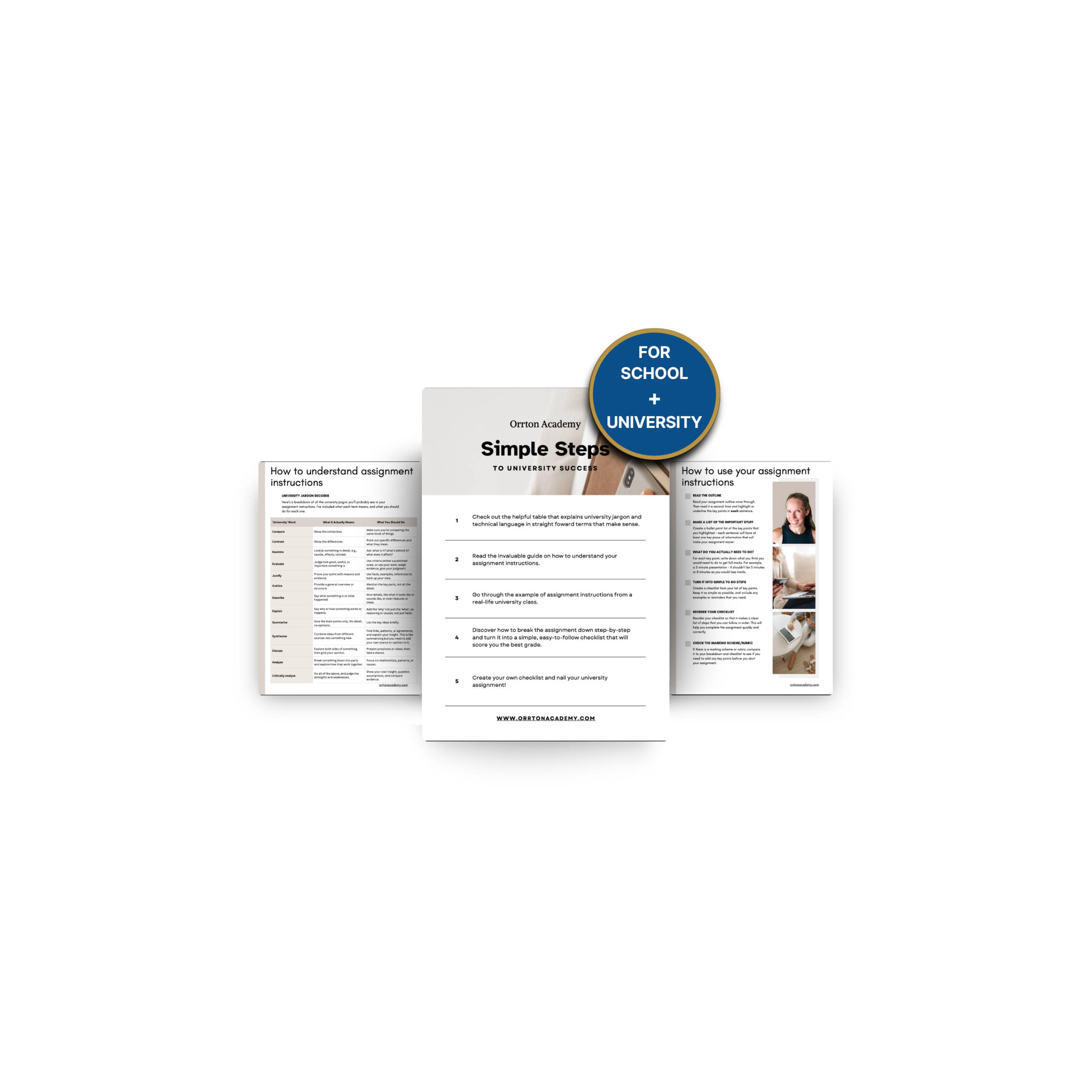
FREE ASSIGNMENT GUIDE
Developed by Dr Theresa Orr.
You’re very welcome!
One of the biggest reasons we lose focus when we’re studying is that we don’t know what we’re supposed to be doing. Sitting down to “study everything” is a recipe for disaster (and scrolling TikTok instead).
Decide in advance what your study session is for. Ask yourself:
- Will I focus on one topic (e.g., photosynthesis, Shakespeare’s tragedies, supply and demand)?
- Will I complete a set number of practice questions (e.g., 10 math problems, 3 chemistry reactions)?
- Will I review one lecture and re-write the key points in my own words?
Breaking your study into specific goals gives you a clear win at the end of each session and makes it easier to focus. Instead of feeling like “I studied for 3 hours but didn’t get anywhere,” you can tick off something real and measurable.
💡Tip
Before exams:
- Count how many topics you need to cover vs. how many study sessions you realistically have left before your exam.
If you’ve got 12 topics and only time for 6 sessions, that’s your signal to adjust your plan now, not the night before the exam.
Even if you don’t have a lot of time left before your exam, planning out what you’re going to do will mean what little study time you have will be useful to you.
Example
Here’s an example Mini Study Schedule:
- Day 1, Session 1: Review Lecture 3 on cell division
- Day 1, Session 2: Practice 10 past exam questions on statistics
- Day 2, Session 3: Make flashcards for key organic chemistry reactions
- Day 2, Session 4: Summarize one chapter of sociology readings in your own words
This way, each session will have a clear purpose, and you can actually see progress building up to your exam.
4. Use Active Study Techniques
If you find that your mind keeps wandering to random things that means that your study is probably too passive. Change what you’re doing to something more active.
Here’s the truth that no-one’s told you… re-reading your notes isn’t studying. It feels productive (you’re highlighting, underlining, maybe even rewriting neatly etc), but that’s passive. Passive study tricks your brain into thinking you know the material when really you’re just recognizing it. Then when you get into the exam you struggle to remember anything.
Active studying, on the other hand, forces you to use the material. That’s what makes it stick (and easy to remember).
Examples of active study techniques:
- Spider diagrams: map how ideas link together (perfect for subjects with theories, timelines, or processes).
- Flashcards: test vocab, formulas, definitions, or organic chemistry reactions.
- Practice questions: recreate exam conditions and identify gaps in your knowledge.
- Teach it out loud: explain the concept as if you’re teaching a friend. If you stumble, that’s where you need to revise.
The key is to match the technique to the subject. Flashcards are brilliant for science or vocab-heavy courses, but for history or sociology, practice essays and teaching aloud are far more effective.
Example
Passive vs. Active Study:
- Passive: Re-reading your psychology lecture slides on memory theories.
- Active: Making a spider diagram comparing the three main theories of memory, then testing yourself by explaining each one out loud without looking at notes.
Try different methods until you find what works best for each subject, and rotate them to stop your study sessions from getting boring.
Read more about using active study methods here.
💡Tip
If you find your mind still wanders even when you’re doing active study methods:
- write down any random thought that you keep having
That way you won’t forget what it is, but it also helps stop you thinking about it. Especially if it’s related to something you need to do later, e.g, laundry or buy something .
5. Reward Yourself
Focus is like a muscle. You can train it to get stronger, but you can’t expect it to lift all day without rest. Especially when you’re first trying to become more focused. Building rewards into your study routine makes focusing over long periods of time easier.. instead of being a battle.
After a full study cycle (say 3 – 4 rounds of 20 minutes with short breaks), give yourself a real reward. Something that feels good enough to signal your brain: “nice work, session done.”
Ideas for study rewards:
- Play a game, scroll social media (guilt-free, because you earned it)
- Watch an episode of your favorite show.
- Go for a run or walk outside.
- Call or message a friend.
- Treat yourself to a snack you actually enjoy (not just another coffee).
Example
Pairing Study & Reward:
- Study block: 4 Pomodoro cycles (20 mins + 5 min breaks).
- Reward: Watch an episode of Ted Lasso.
- Repeat: Back into your next cycle, but now with your brain refreshed.
When your brain knows a reward is coming, it’s far easier to push through the “I don’t feel like it” stage and stay focused during study time.
💡Tip
When you start your “reward time”:
- Set a timer so that you can get into your second round of study
It can be easy to start streaming or doomscrolling and not stop. So setting a timer will help you stay in focused study mode.
6. Different Study Methods for Exams vs. Assignments
Not all study sessions are the same, and the way you focus changes depending on whether you’re studying for an exam or working on an assignment (I’ve only ever used the term “studying” for exams, but I know everyone is different).
For Exams: Your brain can only absorb so much at once.
- Short, timed study blocks with frequent breaks work best here.
For example, 20–30 minutes of focused study followed by a 5–10 minute break helps information settle into long-term memory. - Active recall methods (flashcards, self-quizzing) are perfect.
For Assignments: Writing essays or reports, or reading journal articles, requires longer, uninterrupted time.
- You’ll make real progress in 1–2 hour “deep work” sessions
- Switch off distractions and give yourself space to think, write, and edit.
- Don’t use the Pomodoro Technique (It will just disturb you).
You can read more about how to write your university assignments here.
Example
Match your strategy with your specific study session task:
- Revising for an exam: 20 minutes of flashcards + 5-minute stretch break.
- Writing an essay: 90 minutes of uninterrupted writing + 15-minute walk.
Figuring out which active study methods work for you is important, once you’ve nailed that, decide which methods you want for which session, and for which type of work (exam vs assignment). You’ll end up getting efficient at both studying and productive writing.
Before you start your next assignment, consider this…
Knowing exactly what the question is asking can save you hours of unnecessary research and writing.
I’ve put together the process I teach to break assignment instructions down step by step.
And you can get it for FREE below.
FREE ASSIGNMENT GUIDE
Developed by Dr Theresa Orr.
You’re very welcome!