
Struggling to improve your exam performance despite putting in long hours?
Studying for hours doesn’t always lead to better results. In fact, spending more time re-reading notes or passively reviewing material will usually just leave you feeling frustrated and burnt out, with little to no improvement in your grades to show for it.
The good news? Active recall is a simple strategy that can boost your exam scores without increasing your study hours. It’s a technique backed by science that helps you retain information faster and more effectively.
Why Active Recall Works Better Than Passive Studying

Hi, if you don’t know me, I’m Dr Theresa Orr.
You’re welcome to learn more about how I help students succeed at university with my Uni Pro Accelerator Course.
Most of us naturally rely on passive study methods, like:
- Re-reading notes and textbooks
- Highlighting key points
- Watching lectures multiple times
The problem is that these methods give you a false sense of security, you feel like you know the information but usually struggle to remember it under exam conditions. Active Recall forces your brain to retrieve information, strengthening memory retention and reducing the need for last-minute cramming.
How to Use Active Recall for Exam Success
Here’s how you can apply this technique in three easy steps:
Step 1: Test Yourself Instead of Re-Reading
Instead of passively reviewing notes, turn your study material into questions and test yourself.
✅ Option 1: Use ChatGPT to Generate Questions
If you’re struggling to come up with questions, ChatGPT can help speed up the process. Simply copy and paste your lecture notes or textbook sections and use this prompt:
📝 Example Prompt:
“Can you create 10 quiz-style questions based on this material? Include 4 multiple-choice questions, 3 short-answer questions, and 3 explanation-based questions. List all the correct answers at the end of the quiz instead of after each question.”
Once you have the questions, write or type out your answers from memory before checking your notes. This is a great option as it mimics your exams more realistically, rather than you creating the questions yourself.
✅ Option 2: Create Questions Manually
If you prefer to make them yourself, follow these steps:
- Identify key concepts from your notes.
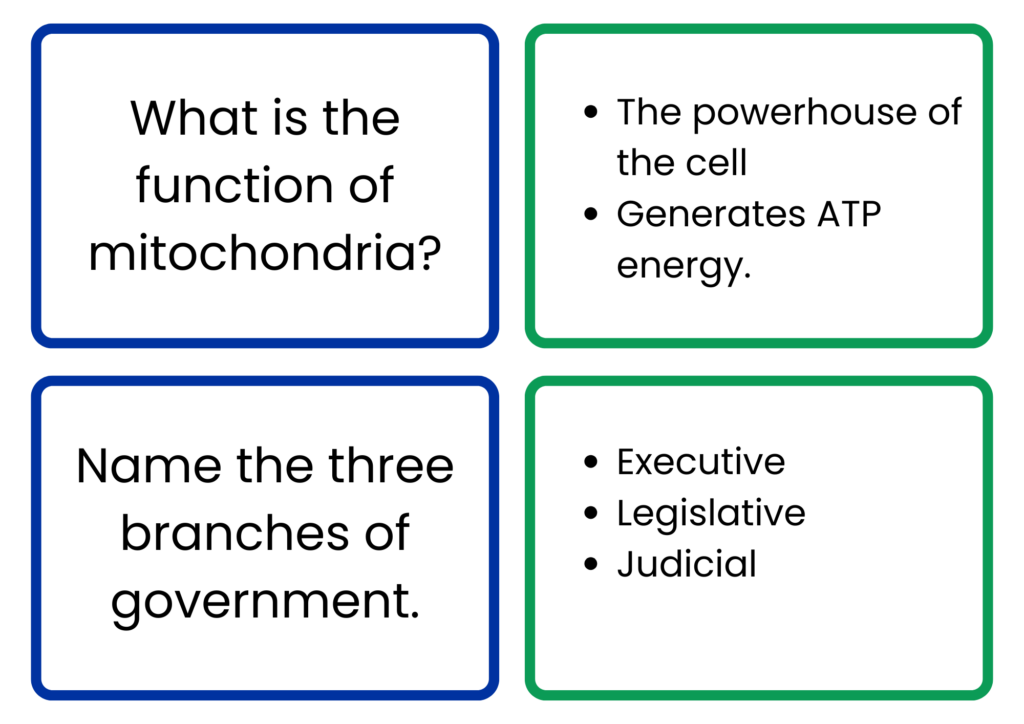
- Turn them into questions—e.g., if your notes say “The mitochondria is the powerhouse of the cell,” your question could be: “What is the function of the mitochondria?”
- Mix up question types—write multiple-choice questions for factual content, short-answer questions for key ideas, and explanation-based (or essay-type) questions for deeper understanding.
- Write your answers from memory before checking.
📌 Example: Instead of re-reading a history chapter, ask yourself: “What were the key causes of World War I?” Then, write out your answer before checking your notes.
If you want to learn how to take effective notes in class to save you study time later – read this post here.
Step 2: Use Flashcards to Reinforce Learning
Flashcards are one of the most effective ways to implement Active Recall.
✅ Method: Create flashcards with a question on one side and the answer on the other. Quiz yourself regularly and separate cards into ‘easy’ and ‘hard’ piles. Focus more on the ones you struggle with.
📌 Example: Studying for a biology exam? Instead of reading about the Krebs Cycle, create flashcards with questions like “What are the key steps of the Krebs Cycle?” and test yourself.
✅ Flashcard Tools:
- Anki (free, great for spaced repetition)
- Quizlet (user-friendly, includes games and testing modes)
- DIY Method: Use index cards and a pen for a hands-on approach.
📌 Flashcard Template Example:
Step 3: Practice with Past Papers and Timed Questions
One of the best ways to prepare for an exam is by simulating exam conditions. Accessing past exam papers is one of the most valuable strategies for effective exam preparation.
✅ Method: Find past papers from your university’s website or library, or ask your lecturer if none are available online. Set a timer and attempt to answer them without looking at your notes.
Why Past Papers Work:
- Helps with time management—by practicing under timed conditions, you’ll feel more confident on exam day.
- Lecturers often reuse or slightly tweak questions—especially for multiple-choice and problem-solving exams.
- Similar structures repeat year after year unless the lecturer or syllabus changes.
- Some universities alternate exam questions every two years, meaning past exams from two or four years ago can be just as relevant.
Where to Find Past Papers:
- Check your university library website (many have an exam archive – see the table below for links to major university archives).
- Ask your lecturer or tutor—some provide practice exams if past papers aren’t publicly available.
Here is a list of several Australian universities and the corresponding links to their past exam paper resources:
| University | Access to Past Exam Papers |
|---|---|
| Edith Cowan University (ECU) | Past Exam Papers |
| James Cook University (JCU) | Past Exams |
| University of Melbourne | Examination Papers 1998–2019 |
| University of New South Wales (UNSW) | Past Exam Papers |
| University of Queensland (UQ) | Past Exam Papers |
| University of Tasmania (UTAS) | Past Exam Papers |
| University of Western Australia (UWA) | Past Exam Papers |
| Western Sydney University | Exam Papers |
Please note that access to past exam papers usually requires your university student credentials (e.g., student number or login), and availability can vary depending on the institution’s policies. If you cannot find past exam papers for your course, it’s best to contact your course coordinator or university library for help.
By practicing with past exam papers, you can simulate exam conditions perfectly, making it easier to identify areas for improvement, and improve your confidence and performance on exam day.
Why Active Recall Works
By consistently retrieving information without looking at your notes, you train your brain to remember key concepts when it matters most—during your exam.
✅ Better retention – You strengthen memory by actively recalling information
✅ Less stress – You feel more prepared and confident going into exams
✅ Higher efficiency – You spend less time studying while learning more.
Before you start your next assignment, consider this…
Knowing exactly what the question is asking can save you hours of unnecessary research and writing.
I’ve put together the process I teach to break assignment instructions down step by step.
And you can get it for FREE below.
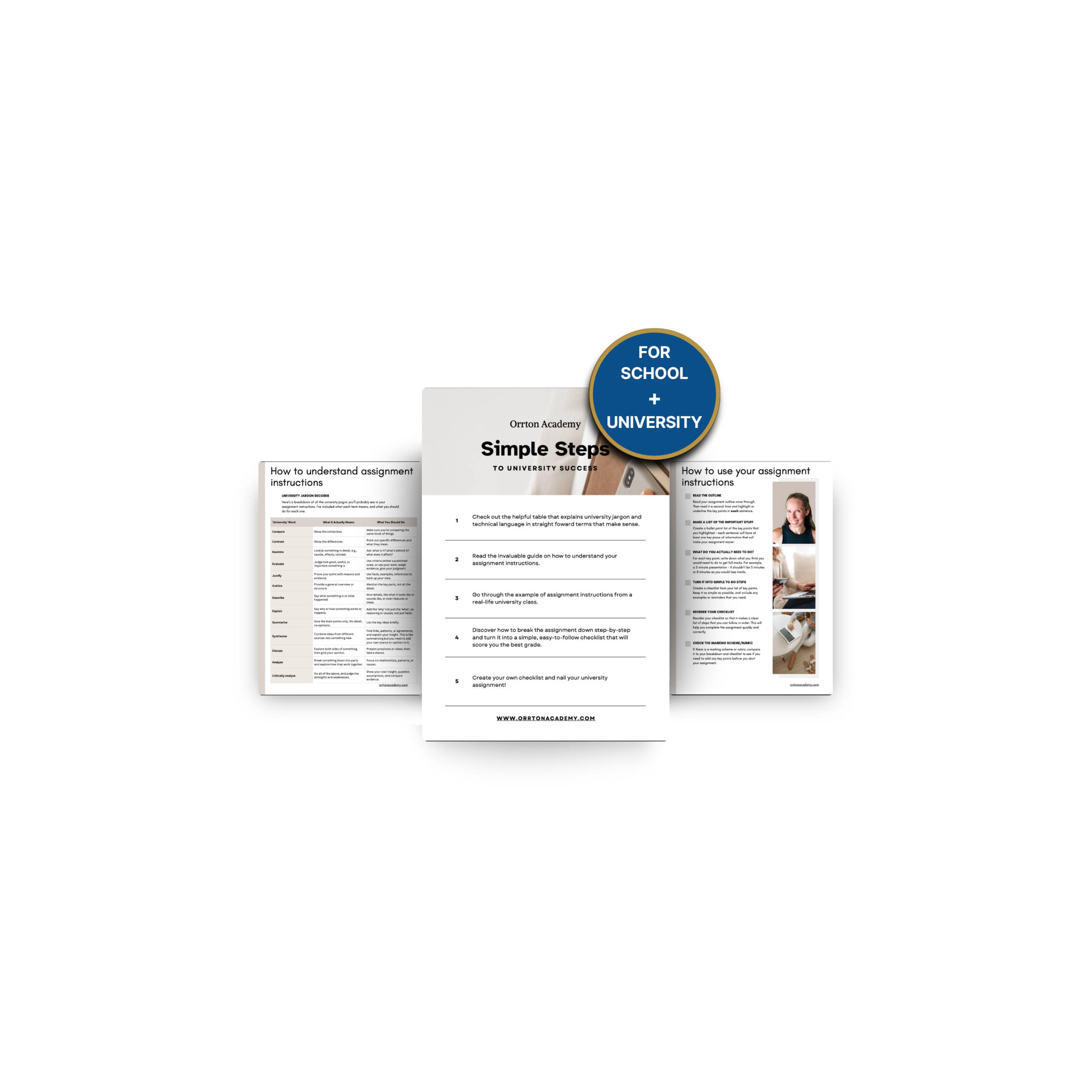
FREE ASSIGNMENT GUIDE
Developed by Dr Theresa Orr.
You’re very welcome!
How to Read a Research Paper Quickly and Effectively
The most effective way to read a research paper quickly is to evaluate the title and abstract before…
![How to Write a University Assignment [4 Simple Steps]](https://theresaorr.com/wp-content/uploads/2026/09/Website-banner-1.png)
How to Write a University Assignment [4 Simple Steps]
The hardest part of a university assignment is figuring out what you’re supposed to do and how…

How To Write A Strong Academic Paragraph (Step-by-Step)
One of the hardest parts of writing is getting each paragraph right. Not because paragraphs are comp…

4 Ways Learning Changes Your Brain
Learning doesn’t just add information to your brain. It changes the very structure of your brain. In…
![How AI Is Changing Universities [From Lectures to Degrees]](https://theresaorr.com/wp-content/uploads/2025/08/Website-banner-9.png)
How AI Is Changing Universities [From Lectures to Degrees]
Universities aren’t disappearing overnight, but AI-driven online platforms are quickly making campus…
![Online vs On-Campus Degree [How AI Is Changing What That Means]](https://theresaorr.com/wp-content/uploads/2023/11/Website-banner.png)
Online vs On-Campus Degree [How AI Is Changing What That Means]
An online degree can be more flexible, more accessible, and easier to fit around work or family life…