

Hi, if you don’t know me, I’m Dr Theresa Orr.
You’re welcome to learn more about how I help students succeed at university with my Uni Pro Accelerator Course.
One in three students takes longer than six years to finish a four-year degree. Here are 12 simple, proven time-management tips I used to graduate on time with the university medal that you can use yourself.
The main thing to remember is not everything at university is a priority. In fact, the most important time management tip is to say no to almost everything. But let’s get into everything else you can do to actually make your university workload manageable…(and maybe even enjoyable)
You can also watch my video on how to manage your time here:
12. Calendars Are Optional (But Finishing Tasks Isn’t)
Using a calendar seems like the most normal and sensible thing to do as a student, especially when we’re juggling so many classes and assessments. It’s also easy to think the best way to manage your time is to plan every hour of your day in a calendar. The trouble is, university does not fit neatly into those boxes at all.
An assessment that looks “small” could actually take three hours instead of one, and switching tasks halfway through just because your calendar says so, usually means more stress and less progress for you.
Do this instead:
- Start with your most urgent assessment (what’s due next?).
- Work on it until it’s finished or you reach a real stop point (e.g., finished one section of it).
- Then move onto the next priority.
Example
Instead of planning to spend “45 minutes on biology, then 30 minutes on earth science,” sit down and finish your earth science prac report.
You’ll save yourself from juggling both, and the report won’t hang over your head later.
Every time you sit down to do some work (assessments or study for exams) plan on finishing one task. Forget everything else until that one task is done.
11. Don’t Cram
It’s tempting to believe that one massive study session the night before an exam will get the job done…and I know that sometimes that’s all the time we have.
I remember when some of my exam blocks were back to back, one exam every day for days in a row. I literally only had the day before to shove every bit of information into my brain before I had to dump it out onto the answer sheet and then shove the next subject’s information in my poor brain.
Unfortunately, the reality is, our brains don’t work well with cramming. To actually understand and remember material, it needs time to process and make connections. When you spread your study out, remembering information becomes much easier on exam day.
Do this:
- Trade one huge study session for 3 – 5 shorter sessions over a few days (or over one day if that’s all you have).
- End each session by writing a 2 – 3 sentence summary of what you learned.
- Start the next session by reading that summary.
💡Tip
Even if you only have two days left, you can still space things out.
- Try one study block in the morning, another in the afternoon, and a quick recap before bed.
That’s still better for your memory than a single 8-hour cram.
10. Stop “Catching Up” on Readings
When you fall behind on weekly readings (and yes… it’s when not if, trust me), our instinct is to try and go back and finish them all. The problem with catching up on our readings is that it takes time away from the work that’s actually due (like major assessments). Sure, readings are important, but attending lectures, finishing pracs, and submitting assessments on time comes first.
Do this instead:
- Complete any assessments (etc) that are due for that week
- If you have time, focus on this week’s readings that link directly to current assessments (don’t go back to the weeks you have missed…yet)
- If you have extra time later, go back to your readings strategically, only go over the parts that will help with your next due task.
Example
If you’re in Week 7 and have an essay due on Friday, don’t waste your time catching up on Week 3 readings.
Read the Week 7 material that connects to the essay topic instead. That way, you’re working with content that actually counts right now.
9. Keep an Empty Timetable (On Purpose)
In your first semester, literally every club, sport, research and volunteering group will want you to join them. These activities can be great, but if you commit to too many, you’ll end up with almost no time to study or do your assessments. There were several students in my year that overcommitted and ended up failing subjects because they spent more time helping out and attending organized events than they did studying.
Remember why you’re at university in the first place: to finish your degree.
I recommend doing this:
- Choose one extra activity you love or that pays (maximum).
- Say no to everything else (for now at least).
- Re-assess next semester if you can take more on without it costing you grades (or your sanity).
💡Tip
When you’re unsure whether to say yes, ask yourself:
- Will this activity help me progress toward my degree or my future career?
If the answer is no, say no.
I also set myself a rule that I’d only help on projects if I was paid. Not because I didn’t want to contribute or help out, but because my time has value, and so does yours. Don’t just volunteer for free because you think it will further your career, paid work will always have a bigger effect.
8. Choose Study Groups With Your Work Ethic
Study groups can either help you to improve your grades or just waste your time. The difference comes down to who’s in the group and what they’re after from their time at university. If the people in the group are focused and genuinely want to learn and get good grades, then it’s a group worth joining. Everyone will bring a different set of skills or knowledge that you can all benefit from. But, if the study group is just full of people that can’t be bothered then they’re nothing more than a distraction, and you’ll leave feeling frustrated and behind.
Do this to make study groups work for you:
- Study with people who want to learn, not just scrape through.
- Set a 45 – 60 minute focus window before any chat or socializing.
- When working on group assignment start a Google Doc so that everyone can be working at the same time.
Example
You’re prepping for a biology exam:
A strong study group could spend an hour working through past paper questions in silence, then take turns testing each other using flash cards for concepts like osmosis or enzyme activity. If someone struggles to explain it clearly, that’s the gap the group tackles next.
The right study group doesn’t just help you pass, it can make studying feel less isolating and even create friends for life. I also loved my study group for being able to have a good vent or whinge after an exam, which was great for destressing.
And just avoid study groups that have these red flags:
- People who are more interested in gossip than coursework.
- Sessions that always turn into social hangouts.
- Members who expect others to do the work for them.
- When phones are out and scrolling happens more than studying.
7. Use Your Learning Style
There’s no one-size-fits-all way to learn. Some people prefer reading and writing, while others like to draw diagrams or talk things out (this is actually my fav way). Sticking to a method that you actually enjoy will make learning easier, which then flows on to make studying for your exams easier too.
Do this
- If you prefer visuals: turn steps into a diagram or flowchart, then test yourself by redrawing it from memory.
- If you prefer verbal: talk through concepts out loud, record a quick note, then quiz yourself later without the notes.
- If you prefer hands-on: work problems by hand, then cover the answers and try again without looking.
Just remember that when it comes to actual study and long-term memory, it’s pretty clear from the research that active recall (testing yourself on the material) is the most effective method. So if you prefer more passive styles of learning (e.g., reading) switch over to something more active for your study.
You can read more about how to use active recall to make your exams easier here.
💡Tip
Before you close your notebook or laptop:
- Try to recall the one biggest idea from what you just covered or learnt.
If you can explain it in a sentence, you’re more likely to remember it tomorrow (and weeks from now).
6. Take Notes Like You Mean It
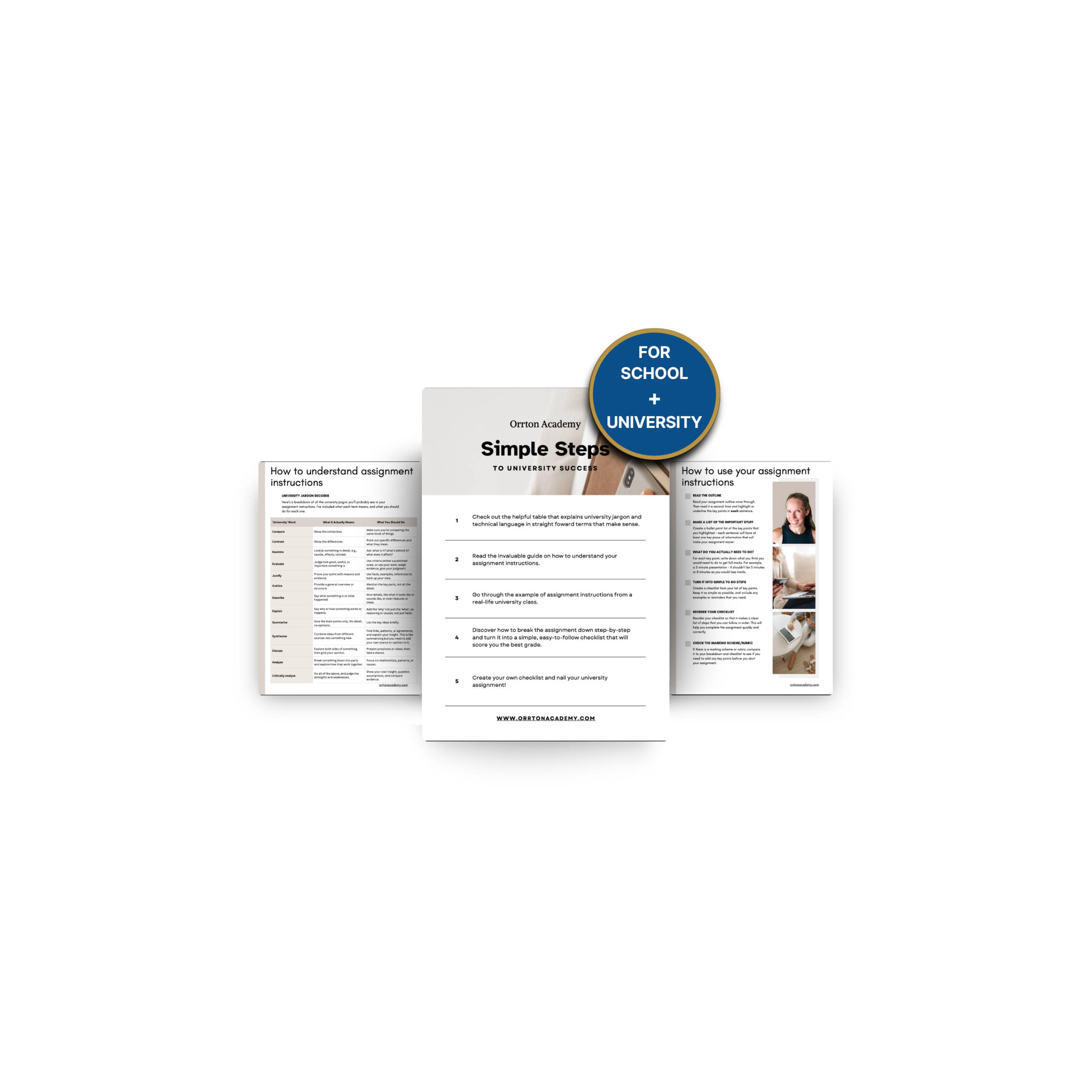
FREE ASSIGNMENT GUIDE
Developed by Dr Theresa Orr.
You’re very welcome!
When I first started university I took notes on absolutely everything. I would spend every lecture frantically trying to get down everything that was said, which meant by the end of the lecture I hadn’t really understood anything, and I was mentally exhausted…aaand my notes were pretty useless come exam time.
I quickly realized that I needed to spend more of my lectures listening to what was said so I could understand it, and less time taking notes…but I also needed my notes so I could have the information later for assessments and exams.
The solution was to prep my notes before class and add my understanding to them during class. That way I was still capturing the important stuff, but I was also processing it as I went.
To take effective notes:
- Skim before class: Set up your notes so you’re ready to add the lecturer’s explanations.
- Listen for extras: Write down what isn’t on the slides (because that’s usually the gold… and almost always on exams).
- Use your own words: One messy sentence in your voice beats a neat block of copied text.
- Go digital: Searchable notes save hours when you’re revising or writing assignments.
If you want to see exactly how I do this, I’ve made a full step-by-step tutorial here.
5. Distraction Shutdown
When you’re studying, your brain tries to literally absorb everything you feed it, even the news or TikToks. It’s all just more information that your brain needs to process, when all you want it to do is focus on understanding and remembering your notes for the exam that’s quickly approaching.
Do this instead:
- During exam prep, no social, no streaming, no news.
- Take real life breaks: walk 10 minutes, stretch, water, snack.
- Keep your phone in another room during deep work.
💡Tip
If you find yourself reaching for your phone out of habit, put it on charge in another room and tell yourself it’s “busy.” Sounds silly, but it works.
4. Move
When your brain feels foggy, no amount of coffee will fix it (I know, I didn’t really believe it either). But what does work is movement. Exercise releases endorphins (the chemicals that help us focus and think more clearly), and even a tiny bit can reset your brain during study marathons.
Here’s what I do:
- Slot exercise in between heavy study blocks so your brain can reset.
- Aim for a minimum achievable amount of movement: a 10-minute walk, a quick stretch, or a 1 km jog if that’s your thing (don’t suddenly register for a half marathon).
💡Tip
Don’t overthink it.
I used to run a 1 km loop around campus as late as midnight sometimes… not because I loved running at that time of night, but because it was usually when I had finished an assessment. It was short, achievable and helped me to relax after a long caffeinated day.
3. Attendance Is Your Golden Ticket
Whether your classes are in person or online, showing up makes a huge difference. Lecturers will often give away subtle hints about what matters most (like what’s going to be on the exam), and it’s the kind of detail that isn’t on the slides. If you’re there to hear it (in the room or logged in online), you’ll always be a step ahead. It also gives you the chance to ask questions, or to hear your lecturer answer other people’s questions.
Do this:
- Treat all contact hours as non-negotiable.
- Write down verbal hints in your notes like “this will be on the exam” or “focus on X.”
- Ask at least one question per session if you can, it shows you’re engaged and clears up confusion straight away.
💡Tip
If your classes are recorded, never rely on catching up later.
Watching the replay rarely gives the same focus as being there in real time.
2. Build Endurance (Stay the Whole Session)
Leaving a prac or tutorial halfway through just means extra work later. The whole point of being there is to finish the task with the support on hand. When you stay the full session, you leave with the work done and the tricky bits already explained, and less work to do later on. This is especially helpful if you have a job and need to be extra efficient with the time you spend on campus.
Do this:
- Use the last 10 – 15 minutes to check your work with a tutor.
- Ask the question now, instead of thinking about it at 11 pm when you’re stuck on your own.
- Remember that staff notice consistent effort. If they see you turning up and staying the whole time, they’re more likely to go the extra mile to help, and yes, that can influence how your work is assessed (i.e., marked).
💡Tip
Even if you finish early, stick around.
- Use the time to review, revise, or ask for feedback on anything in the subject (not just from that session) while you’ve got access to the person marking your work.
1. Complete Every Assessment (Yes, Even the Small Ones)
It’s easy to brush off the quizzes, worksheets, or online submissions that are worth only 1 or 2% and not bother with them. But those small tasks are important for two reasons:
- It’s only the small assessments that you put the theory you are learning in lectures into practice.
- The grades for these small assessments add up to a larger amount (often 10 to 25%). Missing them is one of the fastest ways a passing grade can slip into a fail.
Do this instead:
- Track every task in an Assessment Planner so nothing gets lost.
- Submit the 1 – 2% items on time (every time). They might not feel important, but together they can lift your grade by an entire level.
- Use the small tasks to learn the content for the bigger ones. They’re usually designed to link directly into major assessments.
💡Tip
Think of each small task as free marks. You don’t have to be perfect to collect them, but you do actually have to hand them in.
How to Manage Your Assessment Load
When my workload peaked at 37 assessments in five weeks, I didn’t rely on a calendar. I relied on an Assessment Planner (you can make one yourself, or use a calendar app):
- One column or reminder per subject.
- Every assessment listed with weight, due date, and steps.
- Then backdate every large assessment task for the weeks before it was due.
You can read my step-by-step guide to creating your own assessment planner here:
Quick Start: Do This Today
- Pick one current assessment and work on it until finished.
- Plan three short study sessions this week instead of one long one.
- List every assessment left this term with due dates and weights.
- Cut one extra commitment until exam week for this semester is over.
- Move your body for 10 minutes today.
Before you start your next assignment, consider this…
Knowing exactly what the question is asking can save you hours of unnecessary research and writing.
I’ve put together the process I teach to break assignment instructions down step by step.
And you can get it for FREE below.
FREE ASSIGNMENT GUIDE
Developed by Dr Theresa Orr.
You’re very welcome!